



About I Love My Files
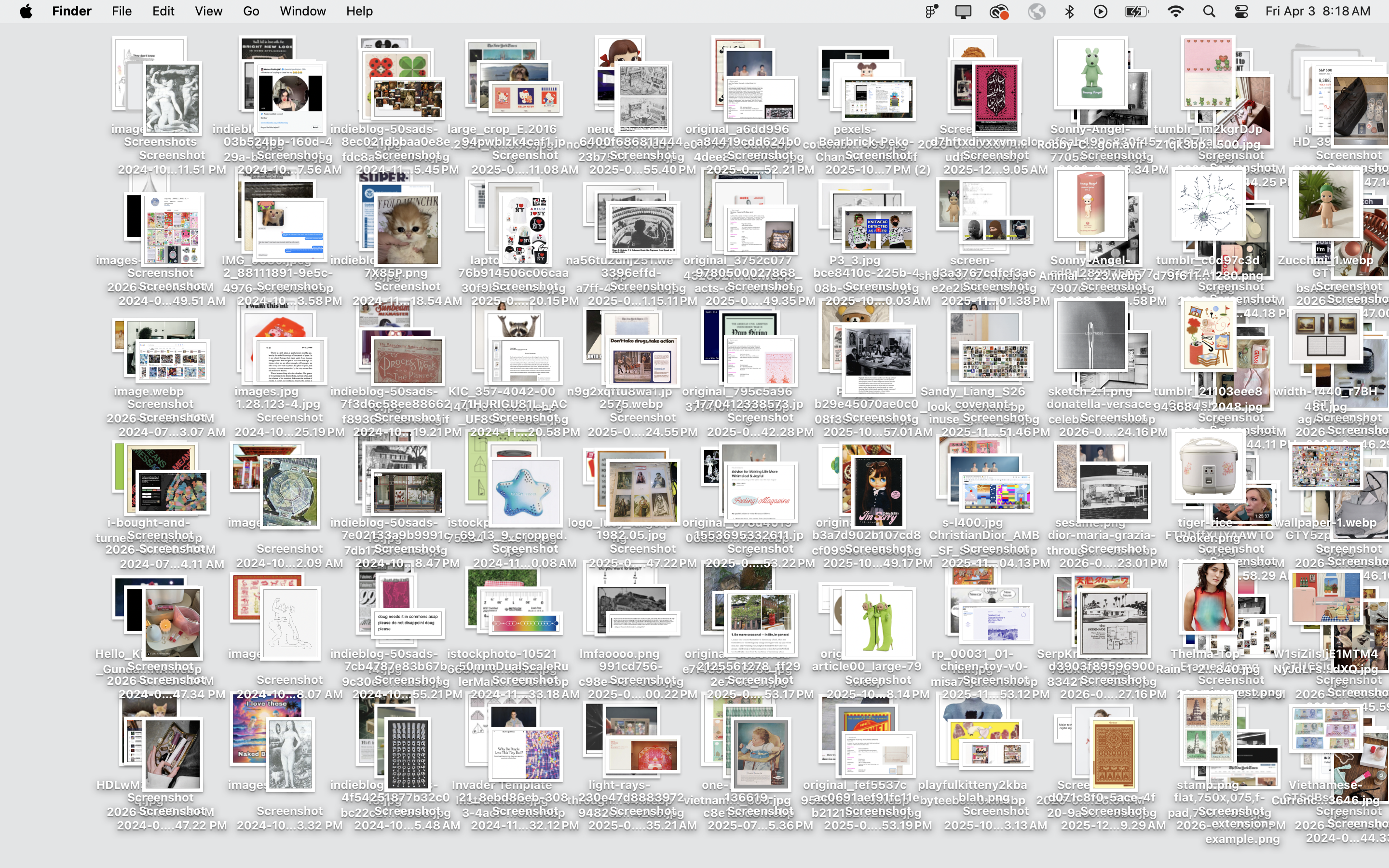
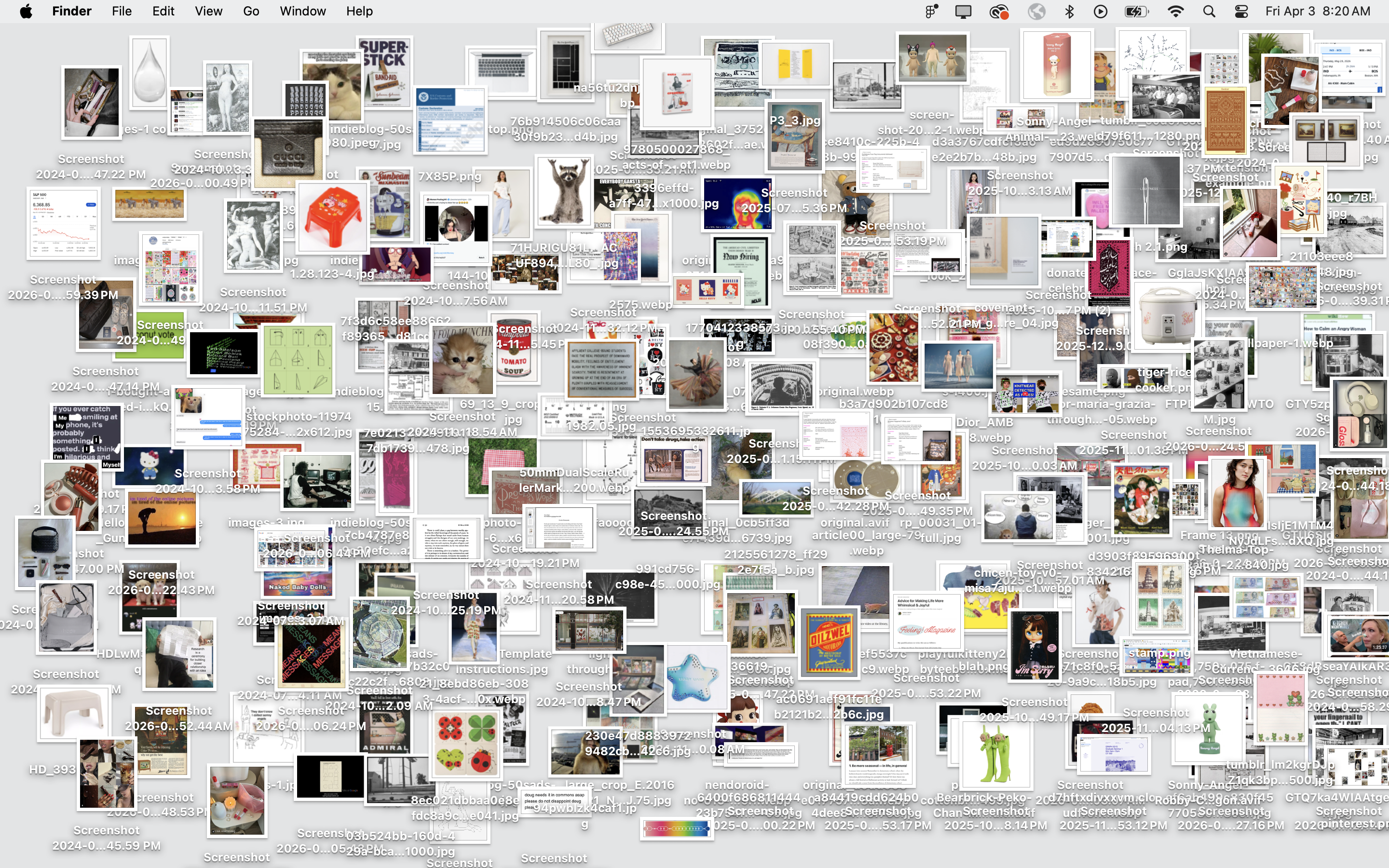
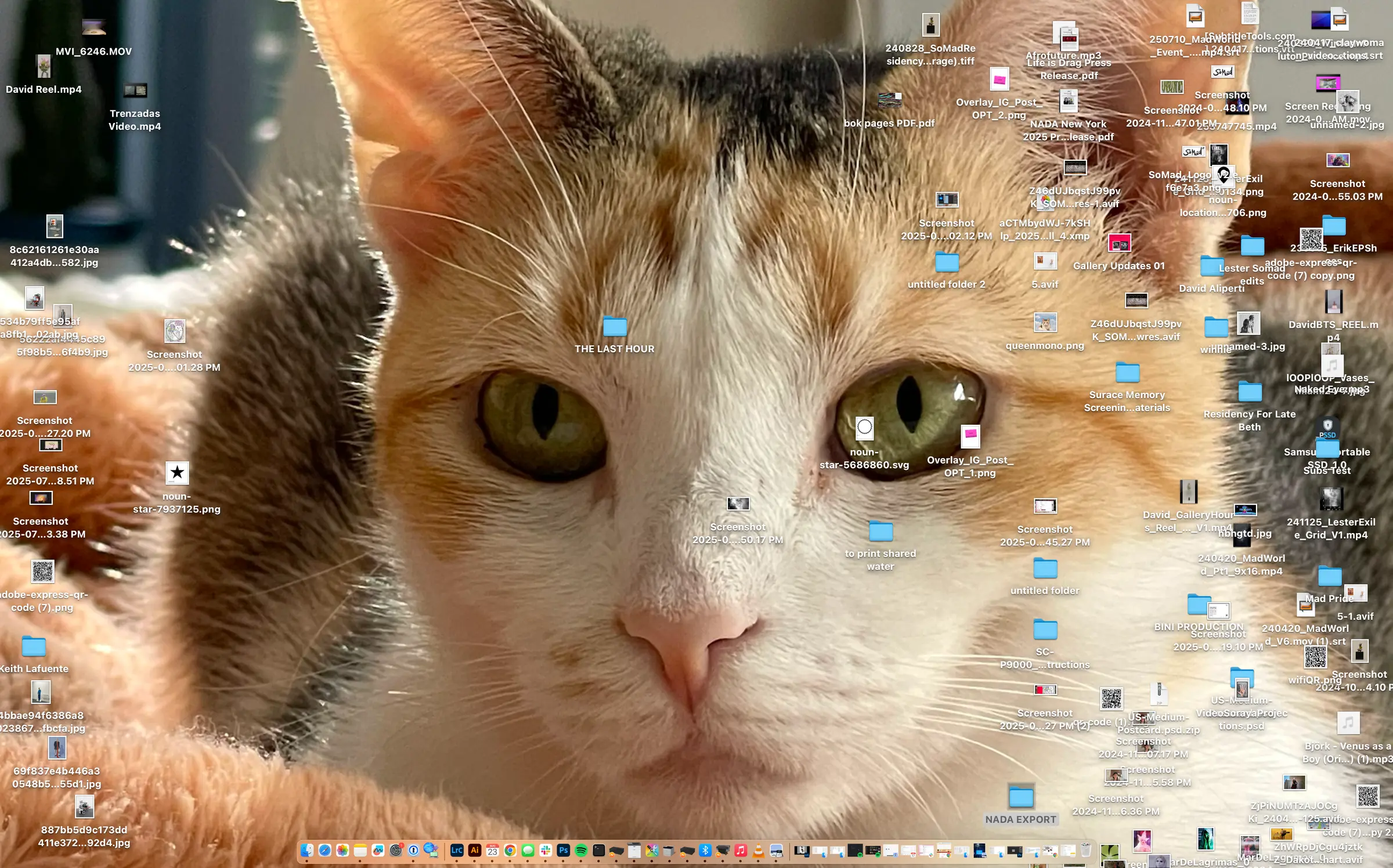
Desktops are ubiquitous spaces in contemporary life, yet they feel so intimate. My heart comes to a stop whenever someone peers over my shoulder to look at my computer. You learn so much by looking at someone’s desktop: what they’re interested in, what they’re working on, what they hope to remember, what they keep secret.
Last summer, I attended Molly Soda’s I <3 Files workshop at Index Space. Through a series of exercises, the workshop shed light on our accumulation of files. By the end, she invited us to distribute our creations in some way, whether we emailed it, put it on a website, etc.
Desktop performances are an emerging practice. Some screen record their desktops to create films and others use it to stage live performances by showing websites or other screen-based work. Molly Soda herself regularly archives her desktop via screenshots and creates collages using her desktop files, and she has distributed her files as physical binders and .zip folders titled mollysstuff. She has recorded herself cleaning up her desktop as another kind of performance. Because the desktop feels so intimate to me, desktop performances feel exhibitionist (even if the “performer” doesn’t feel that way). Whenever someone is showing me something on their computer, I make the conscious effort not to look at files or other windows. At the same time, there’s something thrilling about being able to look at someone’s desktop.
The Hotel is a project-turned-book by Sophie Calle, an artist I admire for her earnestness in exploring human intimacy through herself and others. For three weeks, she worked as a chambermaid in a hotel so she could observe guests through their belongings. As she cleaned rooms, she photographed and took notes of their possessions or the state of the room. When I read the book the year before, I found it creepy and hard to relate to, but upon reflection, I can’t help but relate to the human impulse to surveil others.
So much of my interests relate to the accumulation of media we see online; over time, I’ve become more aware of the relationship between images and voyeurism. Among that abundance, the desktop houses the things we felt compelled to save because these images speak to us, or we want to hold onto memories or information. These collections are incredibly revealing.
I learned about Xu Guanyu when one of his photographs, Facing North, Looking West (2019), was on view at the museum I started working at. The photograph features his childhood home covered in other photographs and ephemera, becoming a queer reclamation of space as his family doesn’t know he is gay. A photograph taped to the refrigerator depicts a pride event, juxtaposed with nearby ephemera from Chinese culture. Another photograph, aptly named My Deskto (2018), features a desk space covered in physical photographs, similar to the other photograph. On top of his desk is an open laptop; on the screen are images of gay men which is taboo considering his family’s conservative background.
The visual texture of Xu’s desktop reminds me of Christopher Clary’s sorry to dump on you like this.zip (2015) which was commissioned by Paul Soulellis as part of The Download, a series at Rhizome which examines the user’s desktop and its files as an exhibition space. Clary’s folder contains 1,860 images of men and gay porn, but the focus isn’t so much on the images but rather the file names which read as dramatic dialogues between lovers. While the images are sexual in nature, the intimacy is found in the file names themselves. This accumulation of images is merely a surface upon which the file names perform.
The taboo nature of our desktop files might also be a result of piracy. Hito Steyerl’s “In Defense of the Poor Image” explores the democratization of viewing images. Nora Deligter writes about how the democratic potential of poor images is reduced when platforms like Netflix actively restrict screenshots, inhibiting our ability to archive, spread, and respond to cultural moments. I often get notifications from Pinterest about the removal of copyrighted material from a Pinterest board, but these images might still exist on my computer; the desktop becomes a safe(r) haven where things are less likely to be removed, unless you try to download a pirated film on RISD’s wi-fi network.
I screenshot to remember or to document evidence. Screenshots are microacts of agency, proving that time spent on a screen was real. Thousands of screenshots, dated and timestamped, operate as documentary photography that reveal what I was looking at. As intimate as they feel to me, my screenshots are rather mundane; most people might not understand their meanings without context. I love the way Kelly Pendergrast described screenshots as a way to “lay claim to the act of seeing, which remains mine alone.”